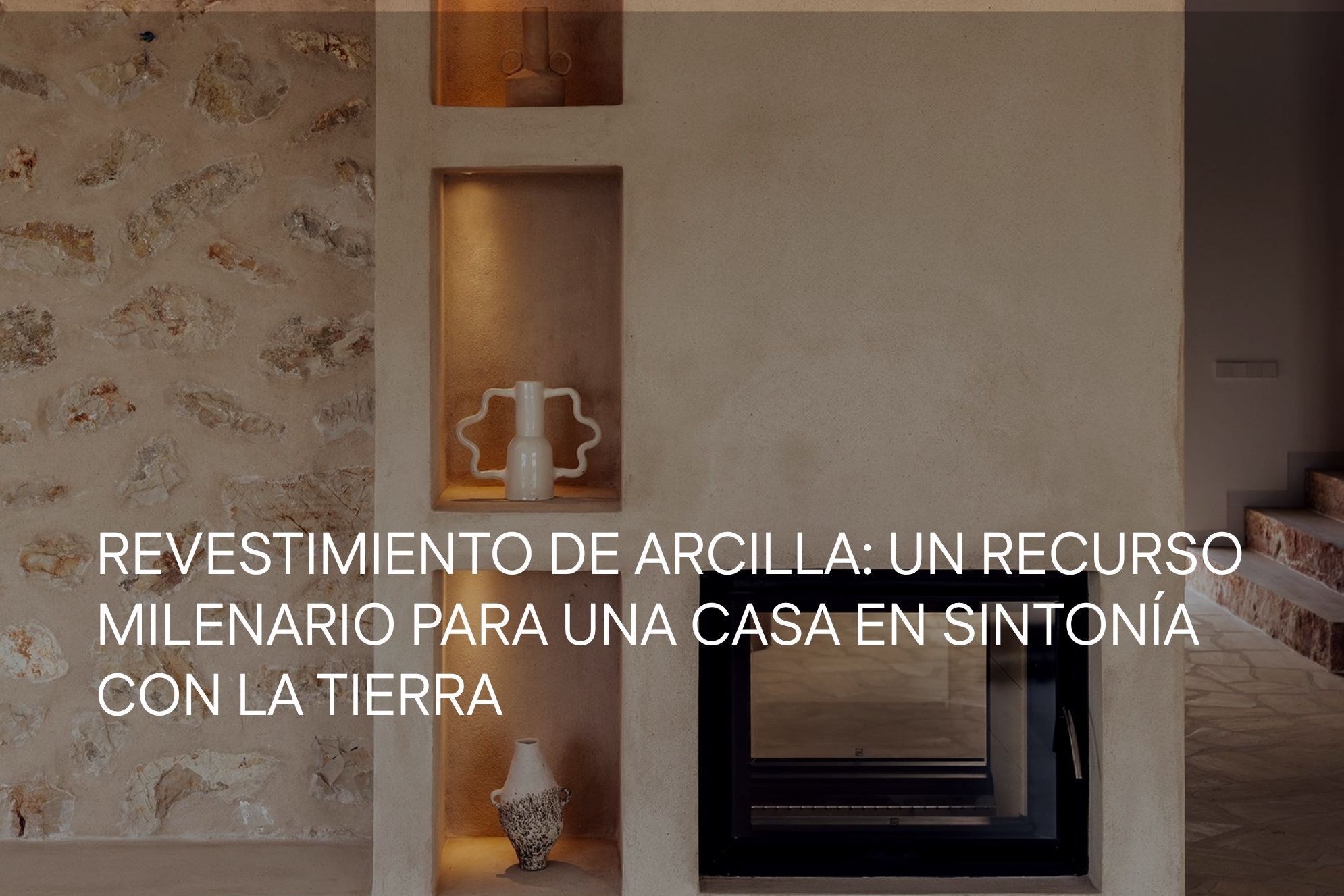
He clay coating We love it and it is usually one of the materials we are asked about the most when talking about a healthy home..
You usually ask us questions like: What exactly is? How does it work? What benefits does it bring?? So we have decided to make this article to explain to you what it consists of, Its benefits and how it can be used, both in homes and office spaces, health and wellness clinics, spas, restaurants, hotels…
All this with real examples of application of this traditional material that has already become a trend, not only for its appearance and texture that inspire well-being, but for its real benefits for the health of people and the planet.
In this article we tell you everything in detail.
Nuestra Newsletter
Sign up and you will receive an email with Reflections, Learning and experiences of my path like bioarchitecta and entrepreneur conscious. I accompany you to create a most consistent life, One more house healthy and a project with purpose.
We are already a community of thousands of people committed to better inhabiting this world, in harmony and with ourselves. Do you join?
Table of contents
What is a clay plaster?
Clay plaster is a natural coating, one of the oldest in existence, what applied to interior walls with considerable thickness, usually around 2 centimeters.
Unlike paint—which is a very thin layer—, clay render creates a thicker layer that actively interacts with the environment.
Now well, It is important to keep in mind that clay always used indoors, since it is not waterproof. For outdoors, It is best to opt for other natural plasters., like lime, which does withstand outdoor humidity and rain and is much more resistant to the elements.
Properties that a good clay plaster should have
So that a coating really contributes to a healthy home, must meet a series of fundamental characteristics:
- – Do not emit toxic substances into the environment
- – Be breathable
- – Have good consistency
- – Be durable
- – Be compatible with the support where it is applied
- – Apply with correct thickness
Clay meets all of these requirements when used correctly., which makes it one of the best interior lining options inside the bioconstruction.
Humidity regulation: the great superpower of clay
One of the most important benefits of clay plaster is its ability to regulate indoor humidity.
A good clay plaster can be:
- – 10 times more absorbent than plaster
- – 5 times more absorbent than lime
This means that clay is able to absorb excess moisture when the environment is stuffy and release it when the air is dry. The result is a natural balance that greatly improves comfort.
Keep in mind that the ideal indoor humidity for people who inhabit an environment is around 50% – 60% (being 55% the recommended optimal value). Although these recommended percentages vary depending on whether it is winter or summer.
That is why this effect not only makes the space more nice and healthy, but also contributes to preventing problems like mold, condensation or excessively dry environments.
Thermal inertia: more comfort with less energy
Another key aspect that we must take into account when talking about interior coatings is the thermal inertia. As long as the clay coating has a minimum thickness 2 cm, will have the ability to store heat and release it slowly.
In fact, it is estimated that he 80% of the air conditioning of a room is directly influenced by the first 2 centimeters of wall.
This means that that small thickness has a significant impact on how the space behaves thermally..
What does this translate into in practice??
- – In winter, the walls keep warm for longer
- – In summer, help preserve freshness
- – And so, the need for air conditioning systems is reduced
It is an effect similar to that of a clay pot versus a metal one.: as our ancestors knew for thousands of years, mud retains temperature for longer, you can create the same effect at home
Cleaner, healthier air
Clay not only regulates humidity and temperature, It also improves the quality of the air we breathe inside the home..
Among its benefits are::
- – Odor absorption: helps maintain a cooler environment
- – Toxic capture: retains harmful substances present in the air
- – More neutral environment: no chemical emissions
All this makes clay plaster an excellent option for a healthy home., in an active skin inside our spaces that always takes care of our health.
The feeling of well-being
In addition to all its technical properties, Clay provides, by its nature, a feeling of well-being.
Its natural origins lead us to build more welcoming environments, feeling of balance and the calm of contact with the earth. Originally, humans lived in caves and, from ancient times until relatively recently, The houses were built with natural and local materials. Consequently, being in contact with the earth makes us, inevitably, feel better.
Formerly, clay plaster was made by hand, and today there are specialized companies that supply clay plaster ready to apply, which professionalizes the process and makes it easier.
At the moment, clay liner is used in spaces as diverse as homes, hotels, cafes and restaurants, clothing stores… It has consolidated itself in bioarchitecture and emotional design, for all its functions that make it easier for us to live in healthier spaces, comfortable and sustainable.
Ultimately, clay coating is one of those materials that reminds us that, many times, The best solutions already existed... we just needed to look at them again.
Are you going to do work or renovation?
Do you want to know more about clay plaster and other bioconstruction solutions??
Whether you are going to build or want to renovate your house to make it healthier, At HabitaBio we can advise you personally throughout this entire process..
Ask us for a session 1:1 free and we explain how: